
The difference between a standard padel court and a premium padel court starts with the glass
When people look at a padel court, they often notice the structure, the turf, the lighting, or the overall design.
But one of the most important elements of a professional padel court is also one of the most underestimated:
the glass.
In padel, glass is not decorative. It is part of the game.
Players use the glass in almost every rally. The ball rebounds from it. Players move close to it, defend with it, attack through it, and trust it during high-speed points.
That means the quality of the glass directly affects:
- Safety
- Ball rebound
- Vibration
- Stability
- Durability
- Visual quality
- Long-term club performance
- Overall player experience
At Olympia Courts, we use 12 mm tempered glass designed for premium padel facilities, professional play, high-usage clubs, and demanding outdoor conditions.
Because in a padel court, not all glass is the same.
1. 12 mm tempered glass: a stronger and more stable playing surface
Olympia Courts uses 12 mm tempered glass, selected to provide a stronger, more rigid, and more premium playing experience.
In padel, glass panels are exposed to continuous impact from the ball, structural vibration, temperature changes, player movement, and long-term outdoor conditions. A premium glass panel must be able to perform consistently over time, not only during the first weeks after installation.
A thicker and better-tempered glass panel helps create a more solid court feeling. It reduces unnecessary vibration and gives players a cleaner, more professional rebound.
For club owners, this is important because a court is not a short-term product. It is a long-term asset that needs to perform every day, under high usage, across thousands of matches.
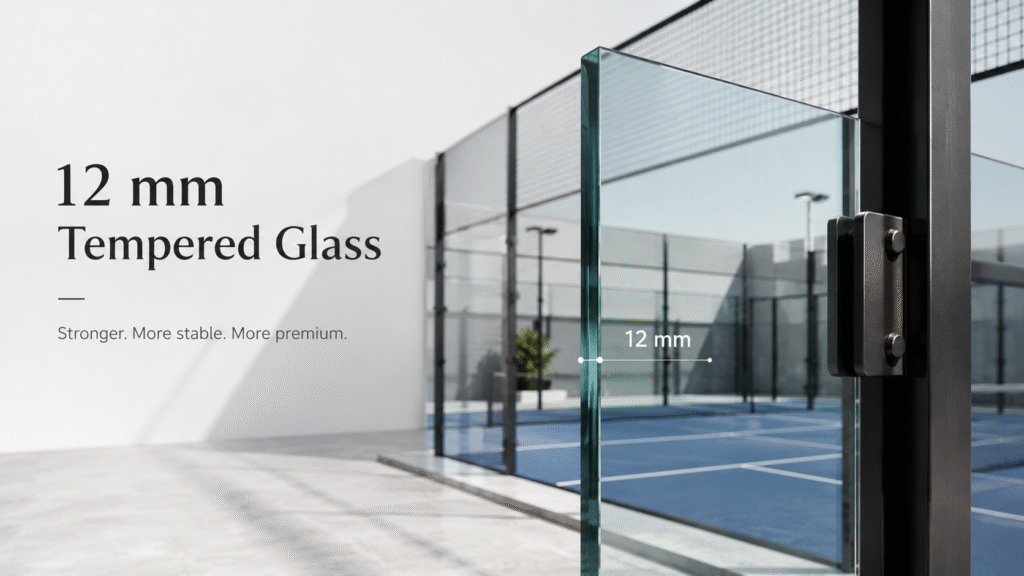
Olympia Courts uses 12 mm tempered glass produced with controlled tempering equipment to ensure consistent strength and stability.
2. EN12150-1 compliance: safety starts with standards
Olympia Courts glass complies with EN12150-1, the European standard for thermally toughened safety glass.
This is important because EN12150-1 defines requirements related to toughened glass performance, including aspects such as strength, flatness, fragmentation behaviour, edge quality, and dimensional tolerances.
For a padel court, this matters because the glass is not just a visual element. It is a safety-critical and performance-critical part of the court.
A premium padel court should not only look good. It should be built with materials that are tested, controlled, and suitable for long-term professional use.
At Olympia Courts, compliance is the starting point. The objective is not only to meet the minimum standard, but to build a better, safer, more stable, and more durable court.
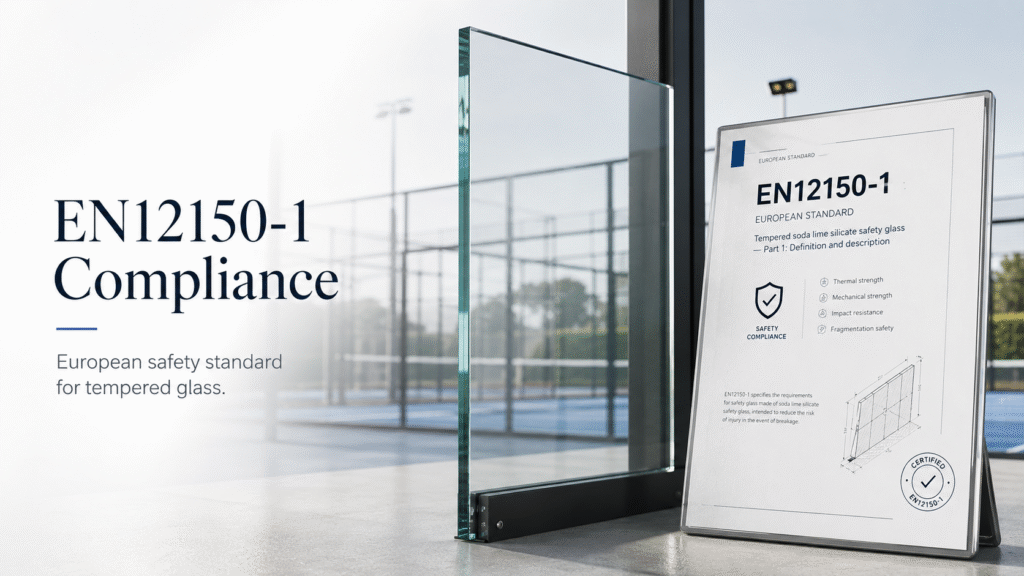
Our tempered glass complies with EN12150-1, the European standard for thermally toughened safety glass, giving clubs confidence in safety, quality, and long-term performance.
3. Higher surface compression: 93-97.7 MPa
One of the most important technical indicators of tempered glass quality is surface compression.
Olympia Courts glass has measured surface compression values of:
95 MPa, 93 MPa, 96.5 MPa, 93.9 MPa, and 97.7 MPa
This gives a measured range of 93-97.7 MPa, above the reference value of 90 MPa.
But what does this mean?
MPa stands for Megapascal. In this context, it measures the compression created on the surface of the glass during the tempering process.
Tempered glass is produced by heating the glass and then cooling it rapidly in a controlled way. This process creates compression on the surface and internal tension inside the glass. The result is a panel with stronger resistance to mechanical stress and thermal stress.
In simple terms:
Higher surface compression means stronger tempered glass.
For a padel court, this helps the glass perform better against:
- Ball impact
- Structural vibration
- Bending stress
- Temperature changes
- Long-term daily usage
Olympia Courts glass does not simply meet the reference value. It performs above it, with measured values between 93 and 97.7 MPa.
This reflects the level of control we expect from a premium glass system.
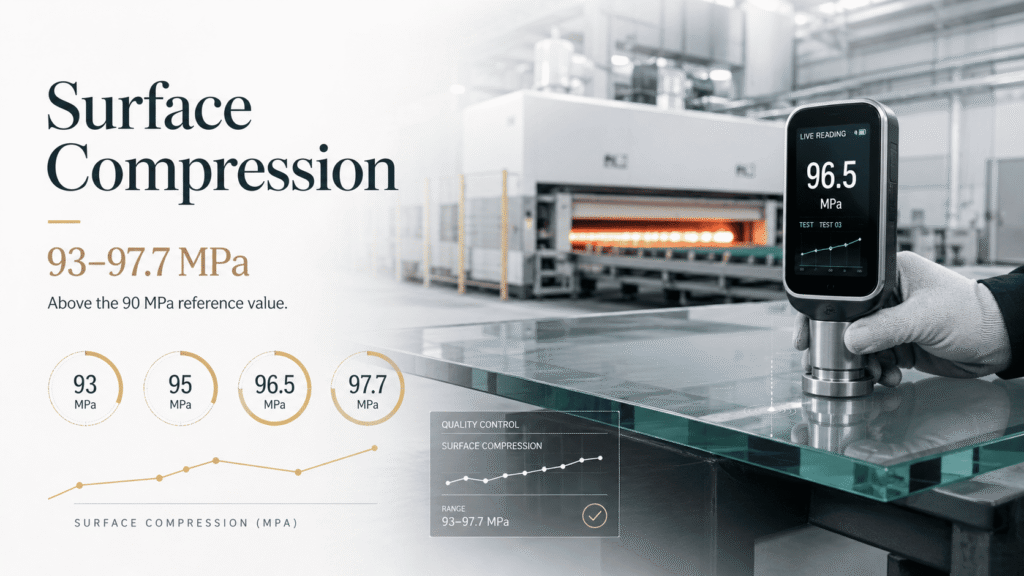
Surface compression measurements between 93 and 97.7 MPa, above the 90 MPa reference value.
4. Controlled tempering equipment for better consistency
Premium glass is not only about the final number. It is also about how consistently the glass is produced.
Olympia Courts glass is manufactured using high-precision tempering equipment, including controlled tempering furnace technology designed to deliver stable surface compression and excellent flatness.
The production process uses controlled heating, intelligent temperature zones, and a complete air-cooling system to stabilize the tempering process.
Why does this matter?
Because uneven tempering can create weak points, inconsistent behaviour, or unwanted distortion across the glass panel.
In a padel court, the glass should behave consistently across the full surface. Players should feel a clean rebound, clubs should have confidence in the material, and the structure should remain stable over time.
A premium court is not only built with better materials. It is built through better process control.
5. Flatness inspection: why the zebra board test matters
Glass quality is not only about strength. It is also about flatness.
After the tempering process, glass flatness can be visually checked using a zebra board inspection. This test helps identify whether the glass surface is smooth and consistent.
When the black and white lines appear uniform, fine, and consistent, it indicates that the furnace temperature and air pressure were well balanced, and that the glass flatness is within the expected range.
When the lines appear irregular, thicker in some areas, distorted, or disorganized, it may indicate uneven heating or flatness deviation.
For padel, this matters because the glass is used as a playing surface. If the panel is not flat enough, the rebound can feel less predictable and the court can lose part of its premium playing quality.
A flatter glass panel contributes to:
- Cleaner rebound
- Better visual quality
- More professional playability
- More premium court perception
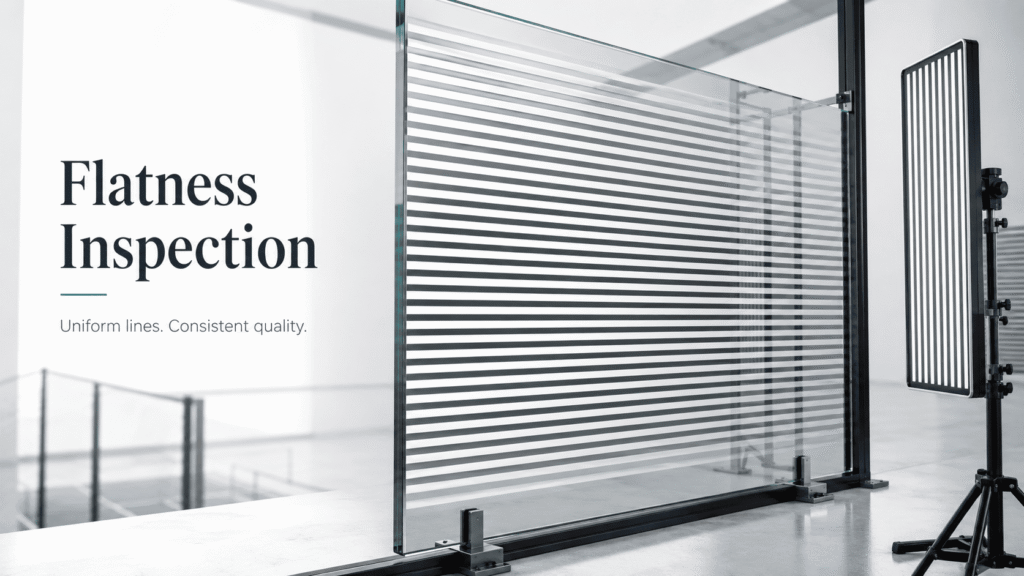
Zebra board inspection helps verify the flatness and consistency of the tempered glass surface.
6. Very low waviness: 0.03-0.06 mm
Olympia Courts glass has very low waviness, with actual measured values of:
0.03 mm, 0.05 mm, and 0.06 mm
The referenced limit is 0.15 mm.
This means the glass performs significantly better than the maximum allowed waviness limit.
Waviness refers to small waves or distortions in the glass surface. These may not always be obvious from a distance, but they can affect both the visual quality of the court and the consistency of the ball rebound.
For players, lower waviness means the glass feels cleaner and more predictable.
For clubs, it means the court looks more premium and maintains a higher-quality finish.
For architects, consultants, and developers, this is the type of technical detail that separates a standard court from a premium sports infrastructure product.
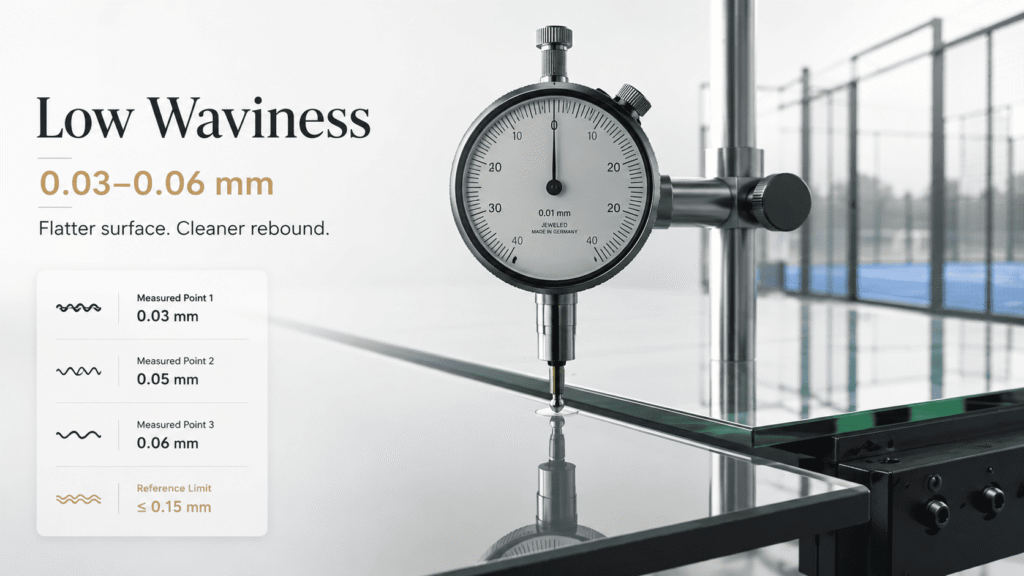
Olympia Courts glass shows very low waviness, with actual measurements of 0.03 mm, 0.05 mm, and 0.06 mm.
7. Excellent flatness: only 0.8 mm curvature in 3 metres
Another important indicator of glass quality is bow or curvature.
The referenced formula allows a maximum bow of 2 mm per metre. For a 3-metre glass panel, this means the maximum permitted bow can reach 6 mm.
Olympia Courts glass was measured at only:
0.8 mm curvature across a 3-metre panel
This is significantly below the maximum permitted tolerance.
Why does this matter?
Because a padel court glass panel is not just a barrier. It is an active rebound surface. If the glass is too curved, the ball can react differently and the panel may feel less stable.
A flatter panel gives the court:
- A more rigid feeling
- Cleaner ball rebound
- Better visual alignment
- A more professional finish
- Greater premium perception
The document also indicates that edge warpage can be controlled at ≤0.20 mm, helping maintain better panel quality and alignment.
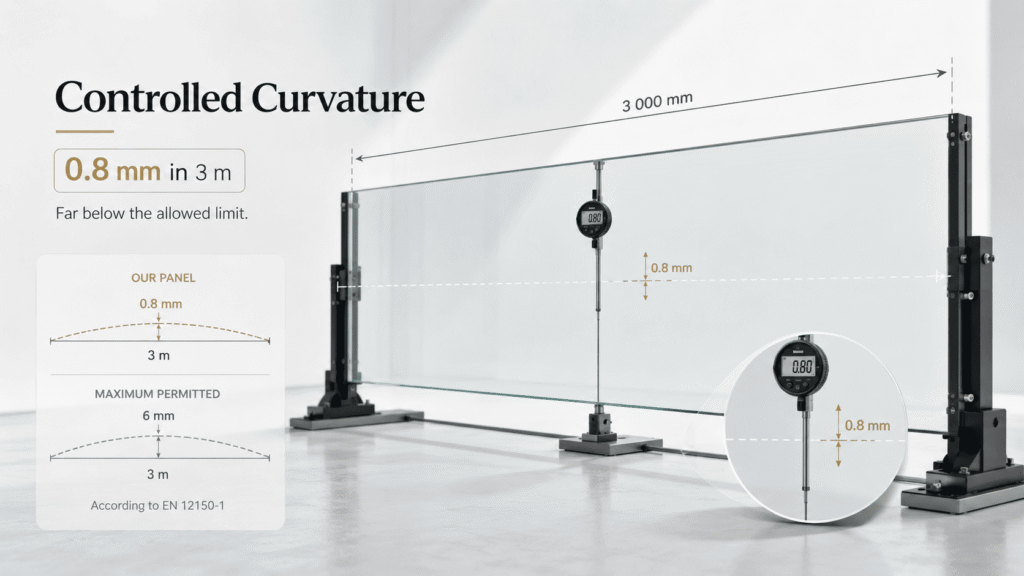
Actual bow measurement of 0.8 mm across a 3-metre glass panel, compared with a maximum permitted tolerance of 6 mm.
8. Fragmentation test: 59 fragments vs minimum 40
Tempered glass is designed to break differently from ordinary glass.
When tempered glass breaks, it should fragment into many smaller pieces instead of large, sharp shards. This fragmentation behaviour is one of the most important safety characteristics of tempered glass.
For 12 mm tempered glass, the referenced test area is 50 mm x 50 mm, with a minimum requirement of 40 fragments.
Olympia Courts glass achieved:
59 fragments in a 50 mm x 50 mm area
This exceeds the minimum requirement.
Why does this matter?
More fragments generally means smaller pieces.
Smaller fragments help reduce the risk of large sharp glass pieces and deep cuts in the event of breakage.
Of course, any broken glass must be treated seriously. If a glass panel breaks, the court should be closed immediately and the panel should be replaced by professionals. Tempered glass reduces risk, but it does not eliminate risk.
However, a better fragmentation pattern is an important safety advantage in a sport where players move fast, play close to the glass, and rely on the court structure during intense rallies.
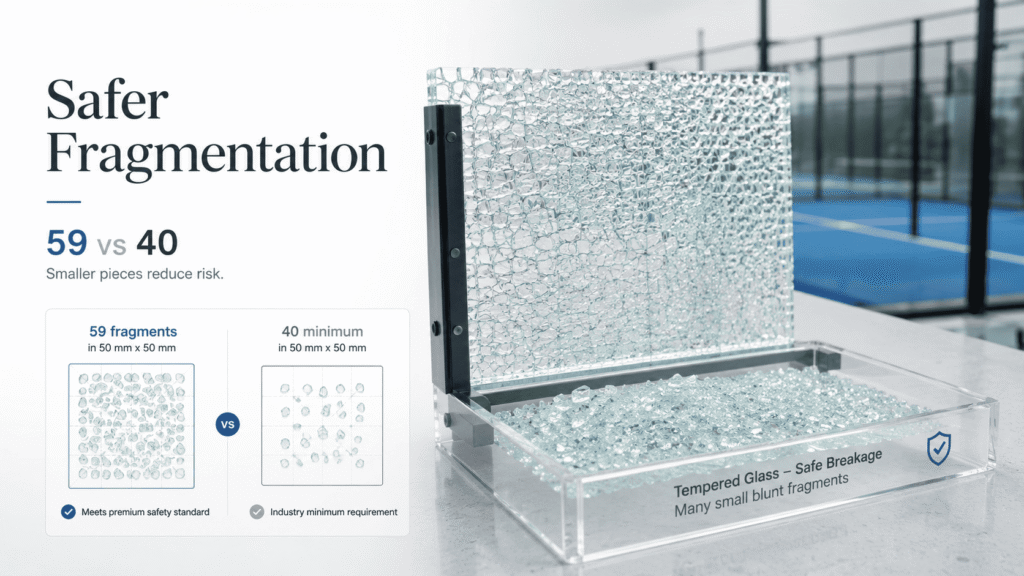
Caption: Fragmentation test showing 59 fragments in a 50 mm x 50 mm area, above the minimum requirement of 40 fragments for 12 mm tempered glass.
9. Load and impact testing: understanding real-world resistance
The document also includes internal factory testing and demonstrations related to load resistance, impact behaviour, and edge durability.
These checks include:
- Three adults jumping continuously on the glass panel
- Repeated brick impact on the glass surface
- Hammer impact from height
- Collision between tempered glass and a wooden box
- Observation of deformation and damage after testing
These tests help demonstrate how the glass behaves under different types of stress.
It is important to clarify that these are practical factory checks and internal demonstrations, not a replacement for official certification standards. However, they are useful to understand the level of confidence placed in the material and the importance of testing glass beyond appearance alone.
For a club owner, this matters because padel court glass must deal with real use, not only laboratory conditions.
Players hit the glass. Balls impact the glass. The structure vibrates. Panels are transported, installed, cleaned, and maintained.
A premium glass system must be prepared for real-world conditions.
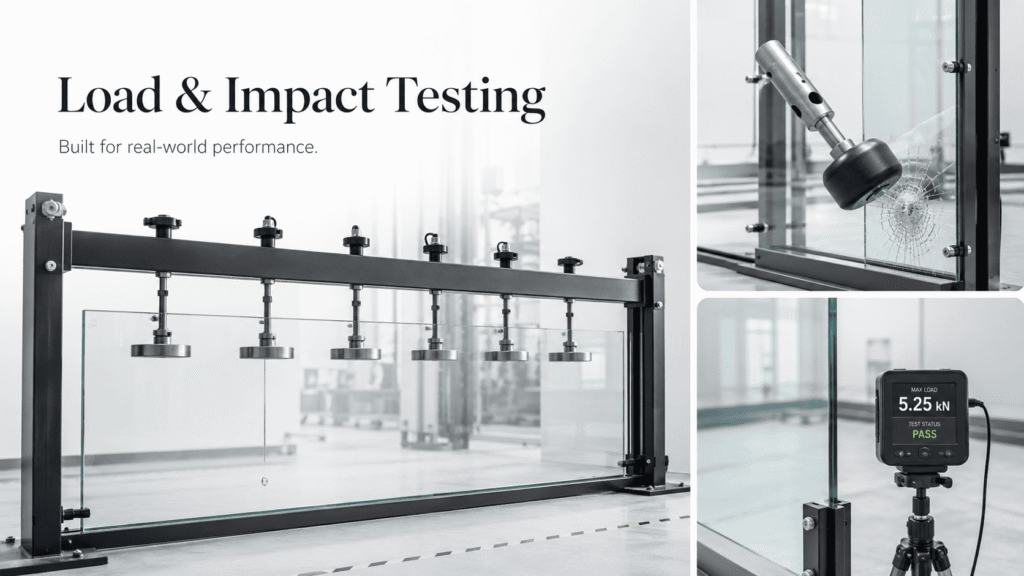
Internal factory checks showing load, impact, and edge resistance testing on tempered glass panels.
10. CNC drilling with controlled tolerances
Another critical detail in padel court glass is the precision of the holes.
Glass panels are connected to the court structure through drilled holes. If these holes are not accurate, the panel can be exposed to unnecessary stress during installation or long-term use.
Olympia Courts glass uses CNC automated drilling with controlled tolerances.
The document indicates:
- Hole diameter tolerance controlled within ±1.0 mm
- Hole position tolerance, from hole centre to glass edge, controlled within ±2.0 mm
This matters because precision reduces installation problems and helps the glass align correctly with the structure.
Poor drilling can create stress concentration around the holes, poor alignment, vibration, or a less professional finish.
In a premium court, every millimetre matters.
CNC drilling helps ensure:
- Better alignment
- Cleaner installation
- More consistent fitting
- Lower stress around connection points
- Better long-term performance
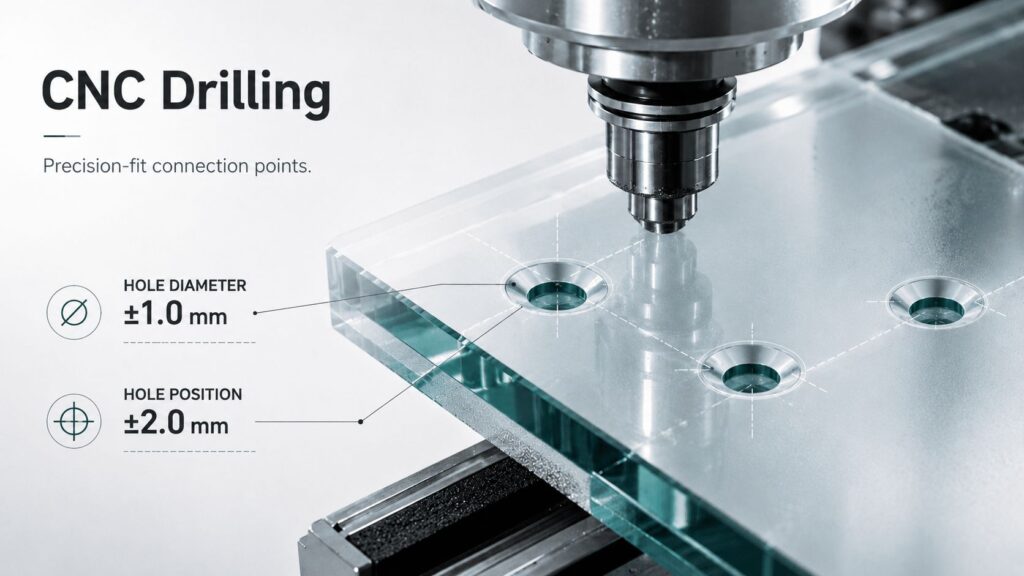
CNC drilling and controlled tolerances help improve installation accuracy and reduce stress concentration around glass holes.
11. Polished edges, bevelled finish, and treated corners
The edges of the glass are one of the most important details for safety and durability.
Olympia Courts glass follows a multi-step edge treatment process:
Rough grinding → fine grinding → edge polishing
The edge is then polished to create a smoother, cleaner, and brighter finish.
All glass edges also receive bevel treatment, usually around 1-2 mm wide at 45 degrees, helping remove sharp edges created during cutting.
The corners are also treated with safety corner processing, removing sharp right angles and creating a small smooth radius.
Why does this matter?
Because glass edges and corners are sensitive areas. Poorly finished edges can increase the risk of chipping, handling damage, installation problems, or stress concentration.
Proper edge and corner treatment helps improve:
- Handling safety
- Installation quality
- Edge durability
- Visual finish
- Reduced stress concentration
- Lower risk of damage during transport and installation
Again, these are details that many people do not see from far away. But they are exactly the details that define whether a court is standard or premium.
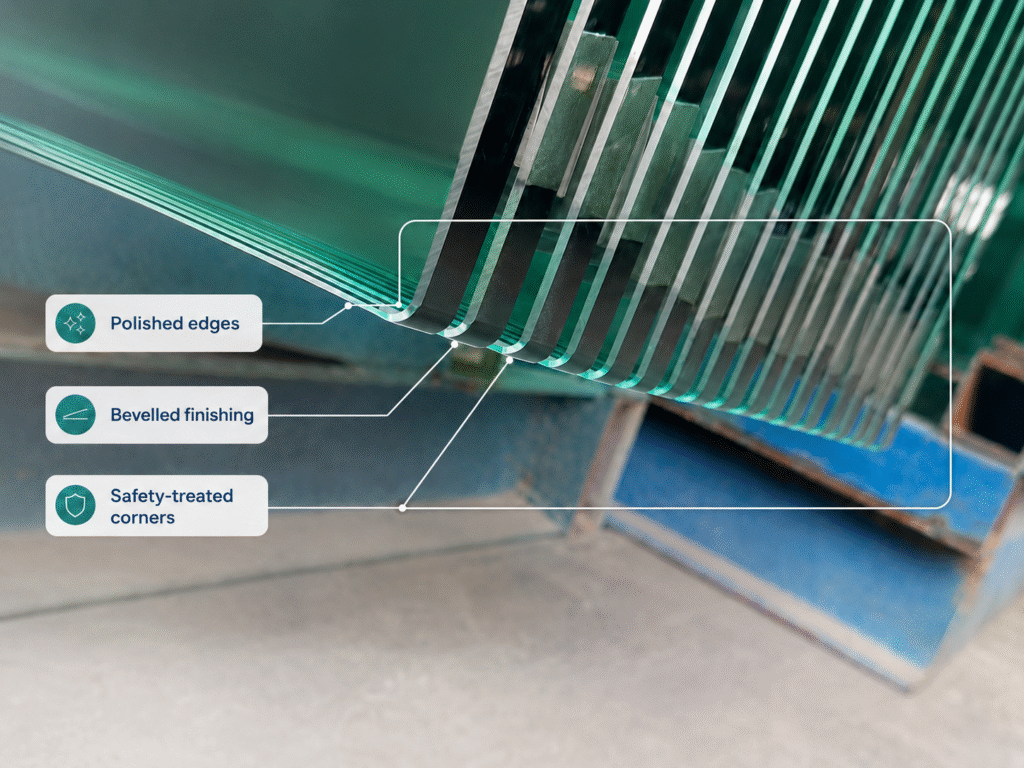
Polished edges, bevelled finishing, and safety-treated corners are key details in premium padel court glass.
12. Why this matters for players
For players, premium glass changes the experience of the game.
A better glass system provides:
- Cleaner rebound
- More predictable ball reaction
- Less vibration
- More solid court feeling
- Greater confidence during rallies
- A more professional playing environment
Players may not always know the technical details behind the glass. But they can feel the difference.
They feel when the court is solid.
They feel when the rebound is consistent.
They feel when the glass vibrates less.
They feel when the facility has been built with higher standards.
In premium clubs, these details become part of the player experience.
13. Why this matters for club owners and investors
For club owners, developers, and investors, glass quality is not only a technical detail. It is a business decision.
A padel court is a long-term asset. It needs to perform every day, attract players, support club reputation, and reduce operational issues over time.
Premium glass helps protect the value of the facility by improving:
- Player satisfaction
- Safety perception
- Court durability
- Brand positioning
- Visual quality
- Long-term performance
- Premium pricing potential
Standard glass may reduce the initial investment, but it can compromise the player experience and the long-term perception of the club.
In a competitive padel market, players remember the quality of the courts. They remember the bounce, the lighting, the turf, the stability, and the overall feeling.
A premium court helps a club position itself above the market.
14. Why this matters for architects, consultants, and contractors
For architects, consultants, contractors, and sports facility developers, glass quality affects more than the sport itself.
It affects:
- Structural integration
- Installation precision
- Visual alignment
- Safety planning
- Long-term maintenance
- Facility perception
- Project quality
A premium padel court should be easy to understand from both a technical and commercial perspective.
Olympia Courts focuses on technical details such as glass flatness, surface compression, drilling tolerances, edge finishing, and fragmentation performance because these elements help create a better final project.
In modern sports infrastructure, design and engineering need to work together.
The court must look premium, but it must also perform like a premium product.
Conclusion: glass is not just transparent
Glass is one of the most important components of a padel court.
It affects the safety, the rebound, the durability, the vibration, the visual quality, and the overall playing experience.
At Olympia Courts, we use 12 mm tempered glass compliant with EN12150-1, with measured surface compression between 93 and 97.7 MPa, very low waviness of 0.03-0.06 mm, only 0.8 mm curvature in 3 metres, 59 fragments in the fragmentation test, CNC drilling, polished edges, bevelled finishing, and safety-treated corners.
Because a premium padel court is not only about how it looks.
It is about how it performs.
It is about how it feels.
It is about how safe, stable, and durable it remains after thousands of games.
Glass is not just transparent.
It is safety.
It is performance.
It is rebound quality.
It is stability.
It is durability.
It is one of the key details that separates a standard padel court from a premium one.
Olympia Courts
Premium padel courts engineered for Asia.