
A padel court is designed to withstand fast-paced play, repeated ball impact, player movement, and constant daily use. But even high-quality glass is not indestructible.
When a glass panel on a padel court breaks, the cause is not always obvious. A strong impact may be responsible, but damage can also develop from edge defects, installation stress, hardware contact, structural movement, or environmental conditions.
For club owners, operators, investors, and facility managers, understanding why padel court glass can fail is important not only for safety, but also for maintenance costs, court availability, and the long-term performance of the facility.
At Olympia Courts, we treat the glass system as an engineered part of the court—not simply a transparent wall.
Why Is Glass Used in Padel Courts?
Glass is one of the defining features of a modern padel court.
Unlike a conventional sports enclosure, padel uses the walls as part of the game. Players can allow the ball to rebound from the glass, which means the wall must provide a predictable and consistent playing surface.
The glass also creates the open visual character that makes padel attractive to spectators, clubs, resorts, hotels, and commercial developments.
According to the International Padel Federation’s rules, the court enclosure can incorporate glass or other suitable materials, provided the walls meet the required characteristics for safe and consistent play. Glass courts must comply with the applicable standards for tempered/plate glass.
This means that the glass is doing more than providing visibility. It is part of the playing system.
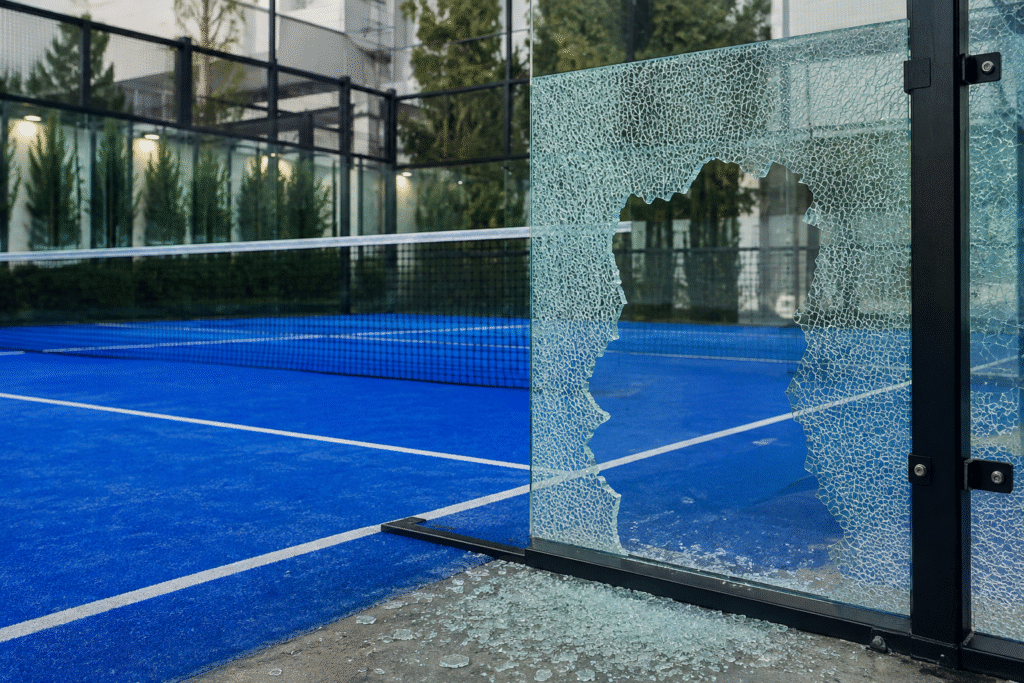
What Causes Padel Court Glass to Break?
There is rarely one universal cause. Glass failure can happen for several different reasons.
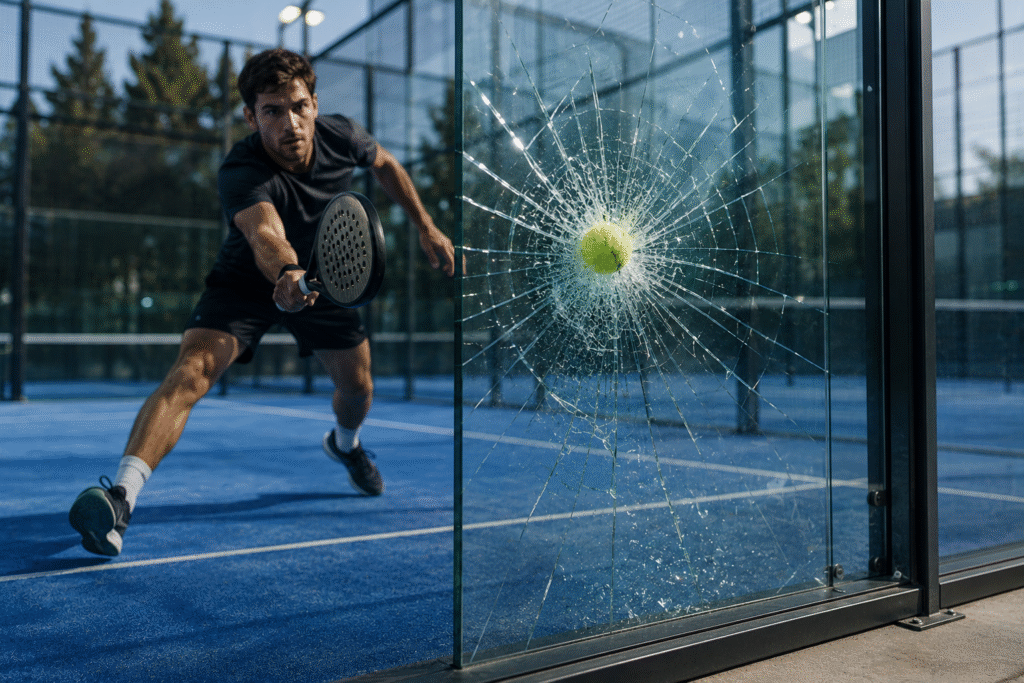
1. Heavy or Concentrated Impact
The most obvious cause is impact.
Padel is a fast sport. Players can move quickly toward the walls, dive, collide with the enclosure, or strike the glass with equipment or other objects.
A properly specified tempered safety-glass system is designed to withstand significant mechanical and thermal stresses. However, no glass should be treated as impact-proof.
The location and nature of an impact matter.
A broad impact on the surface is different from a concentrated impact near an edge, corner, hole, fitting, or previously damaged area. Existing imperfections can make a panel more vulnerable to failure.
This is why glass quality and correct installation are both important.
2. Damage to the Glass Edge
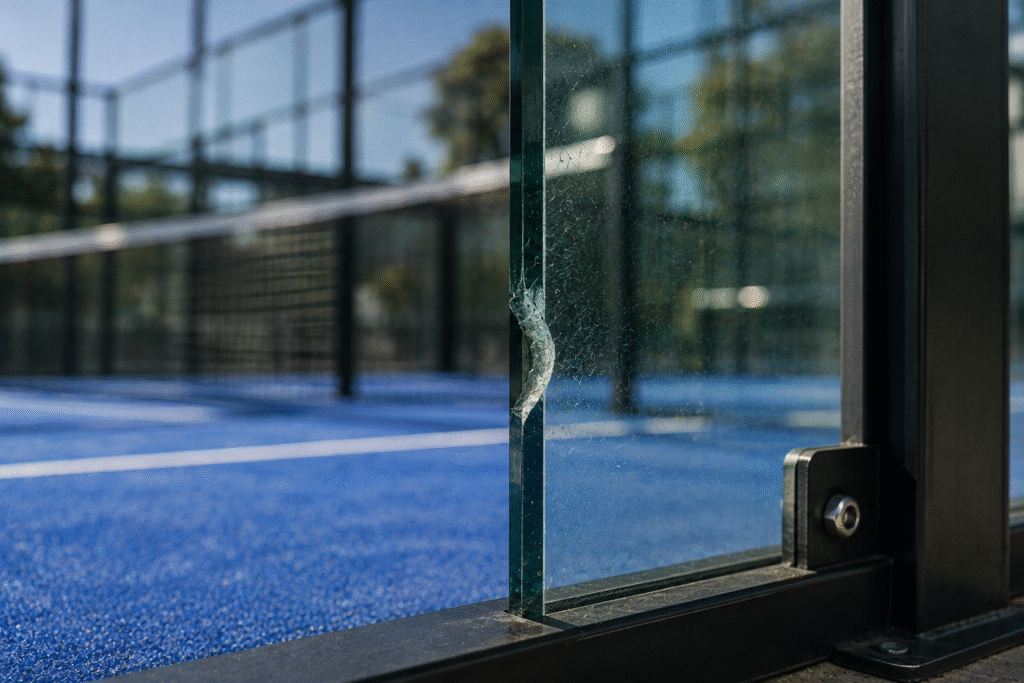
One of the most important areas to protect is the edge of the glass.
Small chips, scratches, or damage around an edge may not immediately result in a broken panel. However, damage can create a weak point that changes how the glass responds to later impact or stress.
During transportation, installation, maintenance, and everyday operation, glass edges need to be handled carefully.
A panel that appears fine after installation should still be inspected if it has experienced a significant impact or visible edge damage.
3. Incorrect Installation or Excessive Stress
Glass does not work independently from the court structure.
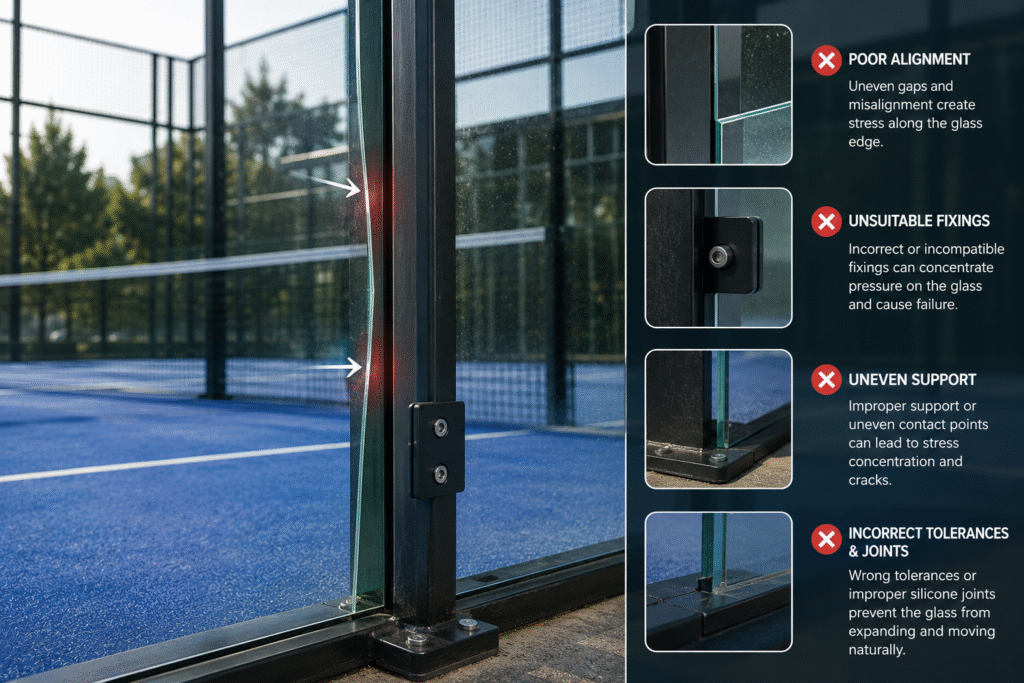
It interacts with steel frames, fixings, brackets, silicone joints, anchors, and other components. If a panel is installed incorrectly, excessive pressure or stress can be transferred to the glass.
For example, poor alignment, unsuitable fixing methods, uneven support, or incorrect tolerances can create unnecessary stress.
This is why professional installation is just as important as selecting the right glass specification.
A high-quality panel cannot compensate for a poorly engineered or incorrectly assembled court.
4. Structural Movement
A padel court is a complete structural system.
The steel frame, anchors, foundations, glass, fencing, and other components must work together. Movement in the structure or foundation can place unwanted stress on glass panels.
This becomes especially important in outdoor courts exposed to:
- Strong winds
- Heavy rain
- Temperature changes
- Humidity
- Coastal conditions
- Frequent player activity
- Long-term structural loading
For this reason, court design needs to account for the actual environment where the court will be installed.
A court designed for one climate or site condition should not automatically be assumed to be suitable for another.
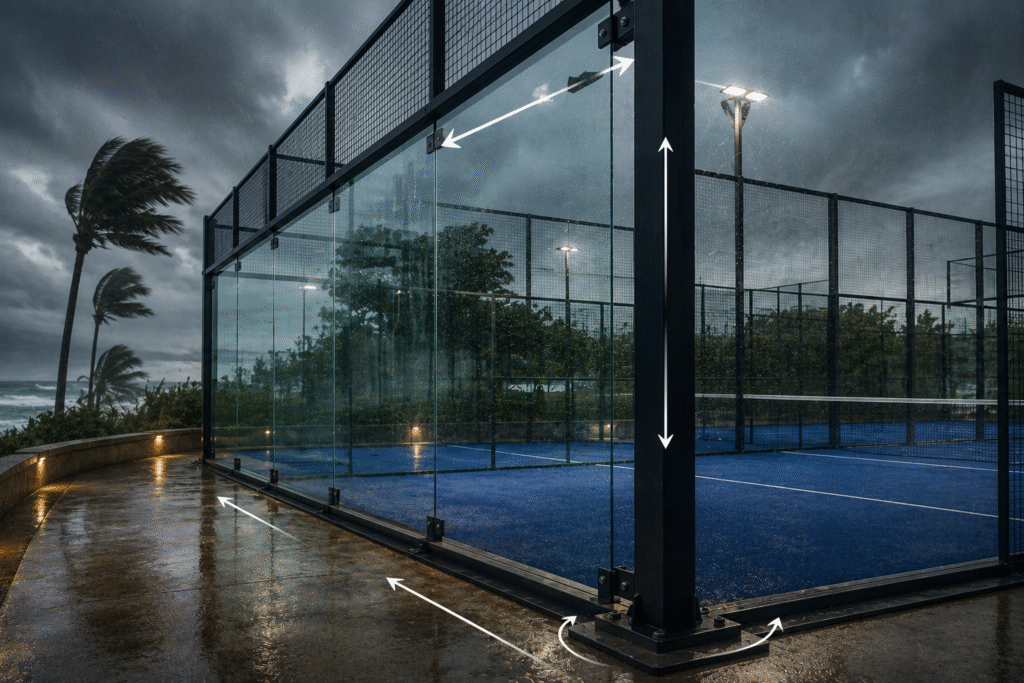
Can Temperature Cause Padel Court Glass to Break?
Temperature and thermal stress can affect glass, particularly when there are existing weaknesses or significant temperature differences across a panel.
Modern tempered safety glass is specifically processed to improve its resistance to mechanical and thermal stress. EN 12150-1 covers the physical and mechanical characteristics, fragmentation, edgework, and other requirements of thermally toughened soda-lime silicate safety glass.
However, “tempered” does not mean “impossible to break.”
Glass specification, manufacturing quality, installation, exposure, and the condition of the panel all matter.
For outdoor padel facilities especially in hot, humid, coastal, or high-exposure environments—the complete court system should be selected with the local climate in mind.
What Happens When Tempered Glass Breaks?
This is an important distinction.
Tempered safety glass is designed to have a safer breakage pattern than ordinary annealed glass. When it fails, it generally breaks into many smaller fragments rather than large, sharp shards.
That does not mean a broken panel is harmless.
Broken glass can still create hazards, and a damaged court should be taken out of service until it has been properly inspected and repaired.
The correct response is to:
- Stop play immediately.
- Keep players and staff away from the damaged area.
- Do not attempt to remove large pieces by hand.
- Prevent players from entering the affected court.
- Have the glass and surrounding structure inspected by qualified personnel.
- Replace the damaged panel and check the associated fixings and structural components before reopening the court.
The important point is that replacing the visible glass alone may not always be enough. If the panel broke because of an installation, structural, or impact-related issue, the surrounding system should also be examined.
Does Thicker Glass Mean a Court Cannot Break?
Not necessarily.
Glass thickness is important, but it is only one part of the specification.
Olympia Courts uses 12 mm tempered glass across its premium court systems, with specific solutions also available depending on the project and safety requirements. Olympia’s M25 Panoramic, for example, specifies 12 mm tempered safety glass as part of its professional glass system.
The quality of the glass, manufacturing process, edge finishing, drilling, installation tolerances, support system, and structural engineering all contribute to the final performance.
For buyers, the better question is therefore not simply:
“How thick is the glass?”
It is:
“What glass system is being supplied, what standards does it meet, and how is it engineered and installed?”
Tempered Glass vs. Laminated Glass
For certain projects, laminated configurations can provide an additional safety characteristic.
Olympia Courts also offers a 6 mm tempered + 6 mm laminated glass configuration. In this type of construction, the interlayer is designed to help keep fragments attached after breakage rather than allowing them to scatter freely.
The appropriate glass solution depends on the project.
A commercial club, resort, residential development, tournament venue, or high-traffic public facility may have different safety, performance, and operational requirements.
The specification should therefore be selected based on the location, expected usage, design, regulations, and project objectives, not simply on price.
What Should You Check Before Opening a Padel Court?
Regular inspection can help identify problems before they become larger issues.
Check the glass
Look for:
- Cracks
- Chips
- Edge damage
- Unusual scratches or defects
- Signs of movement
- Damage around drilled holes or fixing points
Any significant damage should be assessed before the court is returned to play.
Check the fixings and structure
The glass is connected to a larger system.
Inspect relevant:
- Bolts and fixings
- Frames
- Posts
- Anchoring points
- Protective components
- Silicone joints
- Connections around doors and corners
If a glass panel has broken unexpectedly, the surrounding components should receive particular attention.
Check the environment
Outdoor courts require additional attention to environmental exposure.
Humidity, rainfall, salt air, UV exposure, and wind can affect different components of the court over time.
This is particularly relevant across Asia-Pacific, where many facilities operate in tropical, coastal, and high-humidity environments.
Olympia Courts uses hot-dip galvanization and additional protective finishes on its court systems to improve resistance to corrosion in demanding environments.
Prevention Starts Before Installation
The best way to deal with broken glass is to reduce the likelihood of avoidable failures in the first place.
That starts with choosing the right court supplier.
Before purchasing a padel court, ask:
What type of glass is being used?
Is it tempered safety glass? What is the thickness? What standards and certifications apply?
How is the glass installed?
Ask about fixing methods, edge protection, tolerances, joints, and installation procedures.
Is the structure suitable for the location?
An exposed coastal site, rooftop, tropical resort, and indoor sports facility do not necessarily require the same engineering approach.
What happens if something goes wrong?
Understand the supplier’s warranty, replacement process, technical support, and after-sales service before the court is installed.
Is the court designed as a complete system?
Glass, steel, turf, lighting, drainage, anchoring, and installation should work together. Looking at one component in isolation can hide problems elsewhere.
Why Glass Quality Matters to Your Padel Business
For a commercial club, a broken glass panel is more than a repair bill.
It can mean:
- A court being temporarily unavailable
- Cancelled bookings
- Disruption to leagues and tournaments
- Additional maintenance costs
- Customer dissatisfaction
- Replacement and installation expenses
This is why court quality should be viewed as a long-term investment rather than simply an upfront equipment purchase.
Olympia Courts’ approach is to engineer the court around performance, safety, durability, and the environmental conditions of the project. Its current court systems use premium tempered glass together with engineered steel structures, professional turf, lighting, and corrosion-protection systems.
A Broken Glass Panel Is a Warning, Not Just a Repair
When padel court glass breaks, the immediate priority is always safety.
But the incident can also provide useful information about the condition of the court.
Was there a direct impact?
Was the glass already damaged?
Was there stress around a fixing or edge?
Did the structure move?
Was the court installed correctly?
Answering these questions can help prevent the same problem from happening again.
For operators and investors, this is one of the most important lessons: a premium padel court is not defined by how it looks on installation day. It is defined by how reliably the entire system performs over years of use.
Building a Padel Court That Is Designed to Last
Glass is one of the most visible parts of a padel court, but it is only one part of the engineering system.
The right combination of safety glass, structural steel, professional installation, corrosion protection, turf, lighting, drainage, and ongoing maintenance helps create a court that is safer, more reliable, and better suited to long-term commercial use.
At Olympia Courts, we design and manufacture premium padel courts for clubs, resorts, sports facilities, property developments, and investors across Asia-Pacific and international markets. Our approach combines European engineering experience with solutions adapted to the environmental and operational demands of each project.
Planning a Padel Court Project?
Whether you are developing a new padel club, adding courts to an existing sports facility, or integrating padel into a hotel, resort, residential, or commercial development, the right specification starts with understanding your site and your long-term goals.
Tell us where your project is located, how many courts you are considering, and what type of facility you are planning.
Our team can help you identify the right court system, glass specification, structural solution, and installation approach for your project.
Talk to Olympia Courts about your project.