
A complete comparison between tennis, padel and pickleball: court dimensions, history, global growth, prize money, ROI and business opportunity for clubs and investors.
Tennis vs Padel vs Pickleball: The Racket Sports Battle
Racket sports are entering a new era. Tennis is the global giant, pickleball is the explosive American phenomenon, and padel is becoming one of the fastest-growing sports in the world. For investors, clubs, real estate developers and sports operators, the key question is no longer simply which sport is popular? The real question is: which sport offers the best return per square meter, the strongest future growth, and the most attractive business model?
But that’s exactly why the opportunity exists.
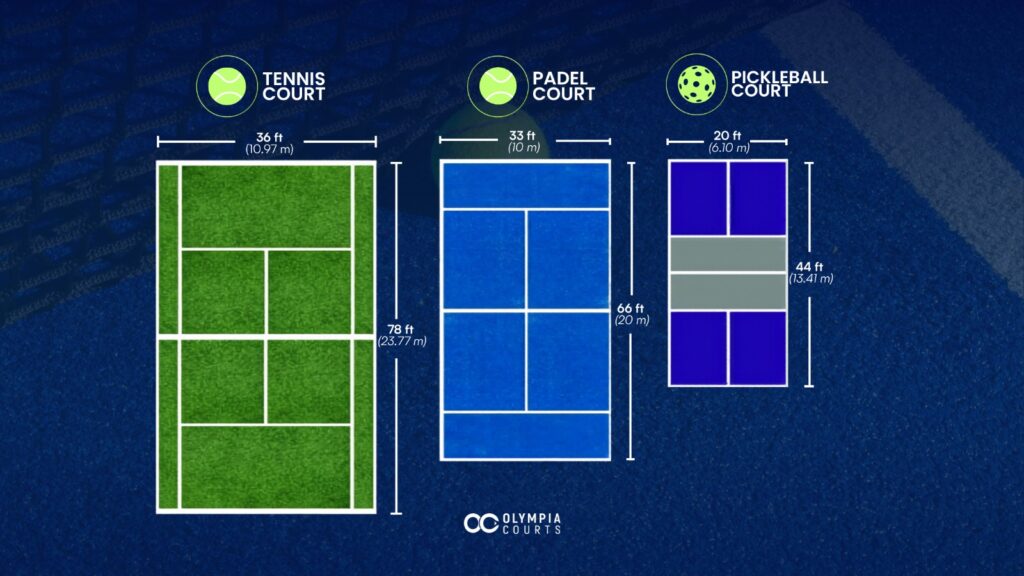
1. Court Dimensions: Space Efficiency Matters
| Sport | Official Court Size | Business Implication |
|---|---|---|
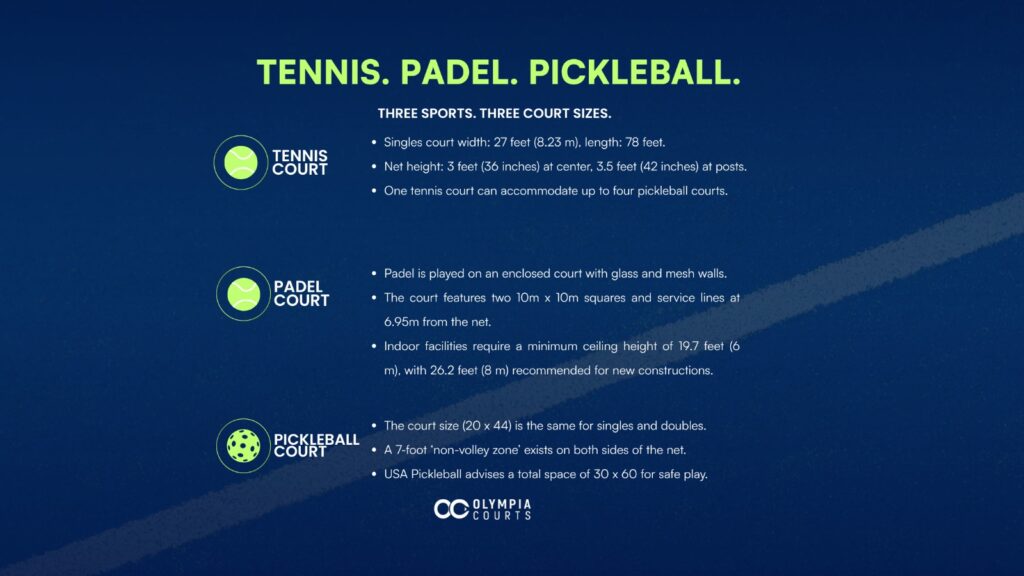
| Tennis | 23.77m long; 8.23m wide for singles and 10.97m for doubles | Large footprint; strong for academies and traditional clubs, but less efficient in dense urban locations. ITF recommends a much larger total competition area around the court. |
| Padel | 20m x 10m | Compact, enclosed and premium. Easier to install in clubs, rooftops, malls, resorts and urban sites. |
| Pickleball | 20ft x 44ft / 6.10m x 13.41m | Very space-efficient and low-cost, especially for conversions of existing tennis/basketball courts. |
From a real estate perspective, tennis is the most established but least space-efficient, pickleball is the easiest to deploy, and padel sits in the premium middle: compact enough for strong ROI, but aspirational enough to generate higher pricing, memberships, events and F&B revenue.
2. History: Three Sports, Three Different Origins
Tennis is the oldest and most institutionalized of the three. Modern lawn tennis developed from older European racket and handball games, and Wimbledon began in 1877 with 22 amateur players at the All England Club.
Padel was invented in 1969 in Acapulco, Mexico, by Enrique Corcuera, who created a smaller 20m x 10m enclosed court because he did not have enough space for a full tennis court. His wife, Viviana, drafted the first rules.
Pickleball was created in 1965 on Bainbridge Island, Washington, using a mix of badminton, tennis and table tennis elements. It later became a major recreational sport in the United States.
The key difference is cultural positioning: tennis is traditional and elite, pickleball is accessible and recreational, while padel combines accessibility with a premium, social and lifestyle-driven image.
3. Global Growth: Players, Courts and Federations
| Metric | Tennis | Padel | Pickleball |
|---|---|---|---|
| Estimated players | Just under 106 million worldwide | Over 35 million worldwide | 24.3 million in the U.S. alone in 2025 |
| Courts | 698,034 tennis courts worldwide | 77,300 padel courts globally | 70,641+ pickleball courts in the U.S. at start of 2025 |
| Geographic reach | Data from 199 countries | Courts across 150 nations and 20 dependent territories | Strongest in the U.S.; international federation claims 76 member federations |
| Growth profile | Mature global sport | Fast international expansion | Explosive U.S. growth |
Tennis remains the largest global racket sport, with almost 106 million players and 698,034 courts worldwide. Asia alone represents 35.3 million tennis players, making it the biggest continent by participation.
Padel is the most international growth story. The FIP World Padel Report 2025 states that padel has surpassed 35 million players, with 24,600+ clubs, 77,300 courts and 14,355 courts built in 2025 alone.
Pickleball is the clearest U.S. growth story. SFIA reports 24.3 million Americans played pickleball in 2025, with 171.8% growth from 2022 to 2025. Pickleheads counted more than 16,210 U.S. facilities and 70,641 courts at the start of 2025, including dedicated courts and temporary-lined courts.
4. Prize Money: Tennis Still Dominates, Padel Is Catching Up
| Sport | Example Big Event Prize Money | What It Shows |
|---|---|---|
| Tennis | 2025 US Open: $90 million total, $5 million for each singles champion | Tennis is still the commercial giant. |
| Tennis | 2026 Roland Garros: €61.7 million total, €2.8 million for each singles champion | Massive global media and sponsor value. |
| Padel | 2025 Paris Major: €1,029,558 prize money | Padel’s professional circuit is growing, but still far below tennis. |
| Padel | 2025 Hexagon Cup: €1.2 million prize pool | New formats are pushing padel into entertainment and media. |
| Pickleball | 2026 PPA Tour: $5.23 million in prize money and appearance fees across event tiers | Pickleball is professionalizing fast, especially in the U.S. |
| Pickleball Asia | PPA Tour Asia: Slam events estimated at US$1 million in prize money and payouts | Pickleball is starting to internationalize, including Asia. |
Tennis is still far ahead in media, sponsorship and athlete earnings. But from an investor perspective, that also means tennis is a mature market. Padel and pickleball are earlier in their professionalization curve, which creates more upside for clubs, leagues, academies, equipment brands and venue operators.
5. ROI and Business Opportunity
Tennis: Stable, prestigious, but space-heavy
Tennis is excellent for established clubs, schools, academies and traditional sports communities. It has global credibility, Olympic status, decades of coaching systems and high-value tournaments. The challenge is real estate efficiency. A proper tennis court requires a large total footprint, and monetization is often limited to 2–4 players per court booking. In expensive urban markets, that makes ROI more difficult unless the club also has a strong academy, membership base or real estate strategy.
Pickleball: Low-cost, fast adoption, but more recreational
Pickleball is attractive because it is easy to learn, cheap to build and highly accessible. It is ideal for community centers, residential projects, schools, multi-sport venues and social clubs. However, its premium positioning is weaker than padel, especially outside the U.S. The professional scene is growing, but the sport is still heavily concentrated in North America. For Asia, pickleball is a good participation product, but not yet as strong as padel for premium club branding.
Padel: The strongest premium club opportunity
Padel has one of the best combinations for sports investors: smaller footprint than tennis, higher perceived value than pickleball, strong doubles participation, social gameplay, premium aesthetics and strong F&B/event potential. A padel court naturally brings four players per booking, creating more community density and better secondary revenue opportunities.
For clubs, padel is not only a sport. It is a social product. Players stay after matches, join leagues, bring friends, take lessons, buy equipment, attend events and become members. This makes padel especially attractive for malls, resorts, rooftops, private clubs, residential developments and sports facilities looking to create lifestyle destinations.
6. The Asia Opportunity
Asia already has a major tennis base, but tennis is mature and infrastructure-heavy. Pickleball is growing, but still needs cultural adoption and premium positioning. Padel, however, is at the sweet spot: the sport is already validated globally, but many Asian markets are still early.
That creates a rare window. In countries like Indonesia, Thailand, Malaysia, the Philippines, Vietnam, Singapore, Japan and India, the market is big enough to be real, but early enough for strong operators to build category leadership.
The biggest opportunity is not simply installing courts. The real opportunity is building complete padel ecosystems: premium courts, academies, leagues, tournaments, memberships, corporate events, sponsorships, retail and F&B.
Conclusion: Which Sport Is the Best Investment?
Tennis is the safest legacy sport.
Pickleball is the lowest-cost participation sport.
Padel is the strongest premium growth opportunity.
For investors and club operators, padel offers the best balance between real estate efficiency, lifestyle positioning, player retention, social engagement and long-term revenue potential. Tennis has the history. Pickleball has the accessibility. But padel has the momentum, the premium appeal and the business model that fits perfectly with the next generation of sports clubs in Asia.
The future of racket sports will not belong to one sport only. But for premium club development, padel is the opportunity investors cannot ignore.