
Padel is no longer a niche European sport. It is becoming one of the most attractive opportunities in the global sports, lifestyle and real estate industries.
Born in Mexico in 1969 and popularized in Spain and Argentina, padel combines the best elements of tennis and squash in a smaller, more social and more accessible format. The result is a sport that is easy to learn, highly engaging and extremely powerful as a business model for clubs, hotels, residential communities, malls and mixed-use developments.
Today, padel is expanding across Europe, the Middle East, Asia and the Americas. For investors and developers in Asia, the timing is especially important: the market is still early, but demand is becoming real.
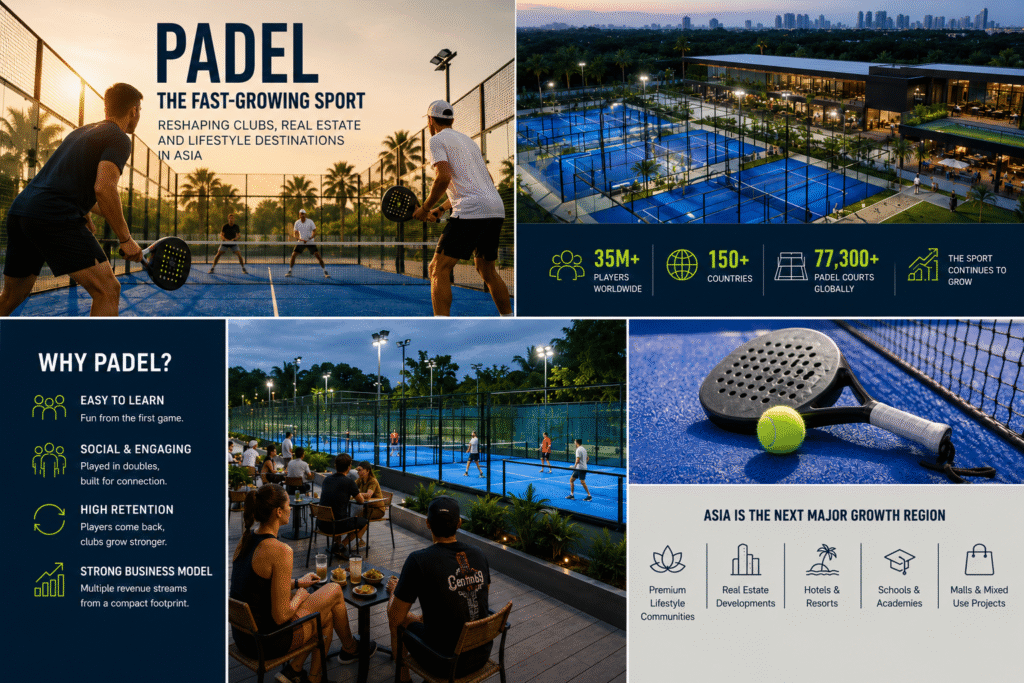
Why Padel Is Growing So Fast
The success of padel is not accidental. The sport has several characteristics that make it ideal for modern consumers and commercial operators.
First, padel is easy to start. New players can enjoy a game from the first session, even without a background in racket sports. The smaller court, underhand serve and use of glass walls make rallies longer and more dynamic.
Second, padel is highly social. It is normally played in doubles, which makes it perfect for communities, corporate groups, families and club environments. Players do not just come to compete; they come to connect.
Third, padel has strong retention. Once players discover the sport, they tend to come back regularly. This creates recurring revenue for clubs through court bookings, memberships, coaching, leagues, tournaments, F&B and retail.
Finally, padel is visually attractive. A well-designed padel court creates energy, movement and atmosphere. This makes it a powerful asset not only for sports clubs, but also for lifestyle destinations, rooftop venues, hotels, resorts and premium real estate projects.
The Global Padel Boom
Padel has already passed the early adoption phase in many markets. Spain is the best example: the sport has become part of daily life, with thousands of courts and a strong ecosystem of clubs, coaches, competitions and brands.
Italy, Sweden, the Netherlands, France, the UK, the UAE, Saudi Arabia and many other markets have followed the same path. As more courts are built, more players enter the sport. As more players join, more clubs, brands and competitions appear. This creates a powerful cycle of growth.
The global infrastructure numbers are now significant. Recent industry reports show tens of thousands of padel courts worldwide and millions of active players across more than 100 countries. The sport is also gaining professional visibility through international circuits, major events and growing media attention.
For investors, this matters because padel is no longer just a trend. It is becoming an established global category.
Why Asia Is the Next Major Growth Region
Asia is one of the most exciting markets for padel because the opportunity is still at an early stage.
In many Asian cities, the lifestyle and sports market is evolving quickly. Consumers are looking for premium experiences, social sports, wellness communities and new activities that fit modern urban life. Padel matches these trends perfectly.
The sport is especially attractive for:
- Private clubs looking to add a high-retention racket sport
- Real estate developers searching for premium amenities
- Hotels and resorts creating lifestyle experiences
- Schools and academies introducing modern sports programs
- Shopping malls and mixed-use developments activating underused spaces
- Investors looking for scalable sports and leisure concepts
Unlike some traditional sports, padel does not require a large field or complex infrastructure. A standard court is compact, efficient and commercially productive. This makes it highly suitable for dense urban environments where land value is high.
In Asia, this is a major advantage.
Padel as a Business Opportunity
For clubs and investors, padel offers several revenue streams from a relatively compact footprint.
A well-run padel facility can generate revenue through:
- Court rental
- Memberships
- Coaching programs
- Tournaments and leagues
- Corporate events
- Sponsorships
- Food and beverage
- Retail and pro-shop sales
- Branded events and community activations
This makes padel more than a court installation. It becomes a community engine.
The strongest clubs are not only building courts; they are building ecosystems. They create regular activities, player levels, coaching pathways, social events and competitive formats. This is what transforms a facility into a destination.
However, the quality of the infrastructure is essential. A beautiful club can lose long-term value if the courts do not perform well, deteriorate quickly or fail to handle local weather conditions.
Why Court Quality Matters
As the padel market grows, the difference between basic courts and premium engineered courts becomes more important.
A padel court is not just glass, steel, turf and lights. It is a sports structure that must deliver safety, playability, durability and a premium player experience.
Key factors include:
- Structural rigidity
- Glass quality and anchoring system
- Turf performance
- Drainage and surface behavior
- Lighting uniformity
- Corrosion protection
- Wind-load resistance
- Safety details around mesh, posts and joints
- Long-term maintenance requirements
- Suitability for local climate
This is especially important in Asia, where many locations face heat, humidity, heavy rain, coastal corrosion, typhoons or rooftop wind exposure.
A court designed for one market may not be suitable for another. For example, a court installed in a tropical coastal environment requires a different level of engineering, coating and structural planning than one installed indoors in a dry climate.
For investors, choosing the right court is not only a technical decision. It directly affects player satisfaction, operating costs, maintenance, safety and return on investment.
The Role of Premium Infrastructure in Asia’s Padel Future
As Asia’s padel market becomes more competitive, players will start to recognize the difference between average courts and professional-quality courts.
The next generation of successful clubs will not be built only on location. They will be built on experience.
Players will choose facilities with better bounce, better lighting, safer structures, stronger aesthetics and more comfortable playing conditions. Investors will choose solutions that last longer, require less maintenance and protect the value of the asset.
This is where premium padel court engineering becomes a major differentiator.
At Olympia Courts, we believe Asia deserves infrastructure designed specifically for the region’s conditions: European engineering standards, Asian manufacturing efficiency and solutions built for tropical climates, coastal environments, rooftops and high-performance clubs.
Our goal is not simply to install courts. Our goal is to help clubs, developers and investors build padel destinations that can grow sustainably for years.
Padel Is Still Early in Asia, But Not for Long
The best opportunities in sports infrastructure usually appear before the market becomes obvious.
In Spain, the clubs that entered early helped shape the entire ecosystem. In the Middle East, early movers built some of the most premium padel destinations in the world. In Asia, that window is open now.
The sport has the right ingredients: social appeal, compact footprint, strong retention, premium positioning and global momentum.
For clubs, developers and investors, the question is no longer whether padel will grow in Asia. The real question is who will build the facilities that define the market.
Padel is more than a sport. It is a lifestyle, a community platform and one of the most exciting opportunities in modern sports infrastructure.
Asia is ready.
Now it is time to build it properly.
Planning a padel club, resort facility, rooftop project or real estate development?
Olympia Courts helps investors, clubs and developers design and build premium padel courts engineered for Asia’s climate, business needs and long-term performance.
Contact Olympia Courts to explore your next padel project.