
“You know the people who opened gyms in Southeast Asia in 2010? They look very smart right now.“
At the time, fitness was still considered niche across much of the region.
A few operators saw something others didn’t:
- rising disposable income,
- growing urban middle classes,
- lifestyle-driven consumers,
- and a shift toward wellness and social experiences.
Fast forward to today, and the fitness industry across Southeast Asia is worth billions.
The people who entered early built:
- dominant gym chains,
- premium boutique brands,
- real estate partnerships,
- and long-term communities around lifestyle and sport.
Padel in Asia feels remarkably similar right now.
Most people still think the sport is “early.”
But that’s exactly why the opportunity exists.
Spain Already Showed What Happens Next
To understand where Asia could go, you only need to look at Spain.
Twenty years ago, padel was still relatively niche.
Today:
- Spain has more than 17,000 courts,
- thousands of clubs,
- professional tournaments,
- academy systems,
- sponsorship ecosystems,
- media coverage,
- and one of the strongest sports communities in Europe.
Padel became deeply integrated into daily social life.
Why?
Because it sits at the intersection of:
- sport,
- entertainment,
- wellness,
- networking,
- and community.
Unlike traditional fitness, padel is inherently social.
People don’t just play for exercise.
They play to meet people, spend time with friends, network, compete, and belong to a community.
That combination is extremely powerful.
And now Southeast Asia is beginning to enter that same cycle.
Indonesia’s Explosion Changed Everything
For years, padel in Asia moved slowly.
Then suddenly, it didn’t.
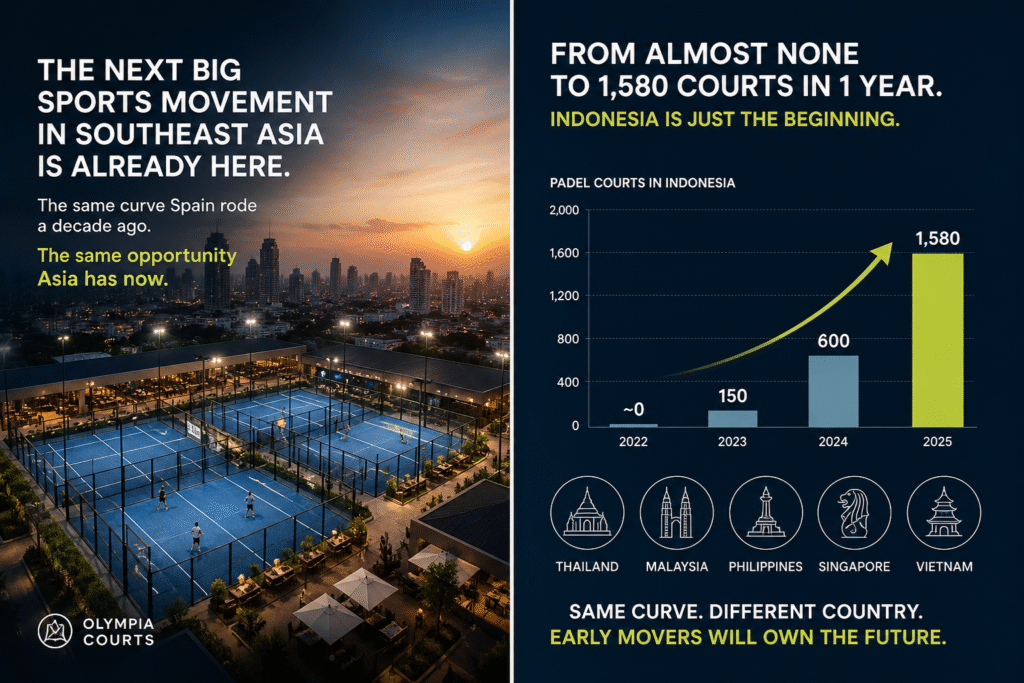
Indonesia had almost no padel courts in 2022.
By 2025, the country built approximately 1,580 courts in a single year.
That number alone changed how many investors, developers, and operators view the market.
Because once a sport proves it can scale that quickly, the conversation changes from:
“Will this work?”
to:
“How big can this become?”
And Indonesia is likely just the beginning.
Southeast Asia Is Entering the Same Growth Curve
Countries like:
- Thailand
- Malaysia
- Philippines
- Singapore
- Vietnam
are now showing many of the same signals Spain experienced during its early growth years.
You can already see:
- clubs opening in premium urban areas,
- hotels adding courts as lifestyle amenities,
- residential developers integrating sports concepts,
- strong demand from expatriate communities,
- local players entering the ecosystem,
- and social media accelerating awareness.
The infrastructure is still young.
But the momentum is becoming very real.
Why Padel Works So Well in Asia
One of the reasons padel grows so fast in Asia is because it matches how modern urban consumers behave.
People increasingly want experiences that combine:
- fitness,
- social interaction,
- networking,
- entertainment,
- and lifestyle.
Padel naturally creates all five.
A padel club is rarely just a sports facility.
The best clubs become:
- social hubs,
- cafes,
- event spaces,
- business networking environments,
- wellness destinations,
- and lifestyle communities.
This is especially important in cities like:
- Bangkok,
- Jakarta,
- Manila,
- Kuala Lumpur,
- Singapore,
- Hong Kong,
- and Bali,
where consumers are already highly engaged with premium lifestyle trends.
Padel also solves one of the biggest problems many sports face:
Accessibility.
Tennis can feel intimidating for beginners.
Golf requires large amounts of time and land.
Football requires large teams.
Padel is easy to start, social from day one, and works extremely well in dense urban environments.
That combination creates fast adoption.
The Real Opportunity Is Not Just Courts
Many people think the opportunity is simply “selling courts.”
But the real ecosystem is much bigger.
The growth of padel creates opportunities in:
- club operations,
- tournaments,
- coaching academies,
- media,
- sponsorship,
- apparel,
- tourism,
- software,
- events,
- hospitality,
- and real estate integration.
That’s why many investors are now looking at padel not as a sport — but as an ecosystem business.
The operators who understand this early will have a massive advantage.
The Window Does Not Stay Open Forever
Every emerging industry goes through a short period where:
- the market is proven,
- demand is accelerating,
- but competition is still fragmented.
That is the sweet spot.
Too early feels risky.
Too late becomes expensive.
Right now, Southeast Asia is entering the phase where:
- awareness already exists,
- demand is growing,
- but the market is still open enough to establish leadership.
That window eventually closes.
The best locations get taken.
Strong brands dominate attention.
Operational standards rise.
Customer acquisition costs increase.
Late entrants struggle to differentiate themselves.
We’ve seen this happen repeatedly across:
- fitness,
- boutique wellness,
- esports,
- coworking,
- and specialty sports concepts.
Padel is now following a similar trajectory.
Building Correctly Matters
Fast-growing industries also attract low-quality execution.
And in padel, poor execution becomes very expensive.
Asia presents unique challenges:
- tropical climates,
- humidity,
- heavy rainfall,
- coastal corrosion,
- rooftop engineering,
- logistics complexity,
- operational inefficiencies,
- and inconsistent construction standards.
Building a successful padel club is not just about installing four courts.
It requires understanding:
- player experience,
- court engineering,
- durability,
- club operations,
- spacing,
- lighting,
- circulation,
- hospitality integration,
- and long-term maintenance.
The difference between a premium club and an average one is enormous.
And in emerging markets, first impressions shape the entire industry.
The Next Five Years Will Define the Market
What happens over the next few years in Southeast Asia will likely determine:
- who becomes the leading operators,
- which brands dominate,
- and which clubs become long-term reference points.
Many of the strongest businesses in mature industries were built during moments exactly like this.
Not when the market was saturated.
But when it was just beginning to accelerate.
At Olympia Courts, we work with investors, developers, clubs, and operators across Asia-Pacific to build premium padel projects adapted specifically for the region.
Because timing matters.
But execution matters even more.
🎾 The Southeast Asian padel boom is no longer a prediction.
It’s already happening.